Download Champions' AACR 2026 Poster #7213
Evaluation of Folate Receptor-Alpha Antibody-Drug Conjugate Mirvetuximab Soravtansine-Gynx in Ovarian Cancer PDXs
Poster #7213, presented at AACR 2026
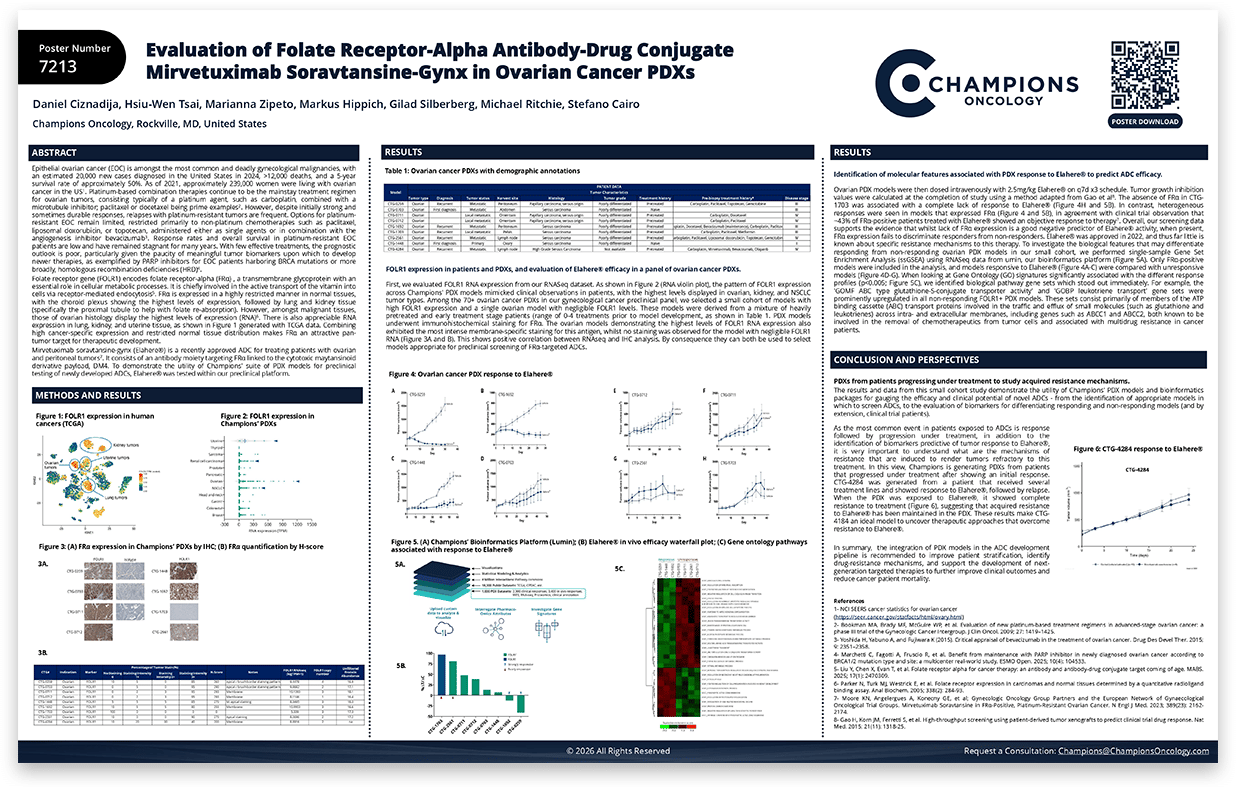
Epithelial ovarian cancer (EOC) remains one of the most lethal gynecologic malignancies, with approximately 20,000 new cases and over 12,000 deaths annually in the United States. Despite initial responsiveness to platinum-based combination chemotherapy, most patients relapse with platinum-resistant disease. Folate receptor-alpha (FRα), a membrane glycoprotein responsible for folate transport, is minimally expressed in normal tissues but highly expressed in ovarian and certain other epithelial cancers, making it an attractive therapeutic target. Elevated FRα expression correlates with reduced overall survival across tumor types, reinforcing its clinical relevance. Mirvetuximab soravtansine-gynx (Elahere®) is an FRα-targeting Antibody-drug conjugate (ADC) that couples an anti-FRα antibody with the cytotoxic maytansinoid derivative DM4. Preclinical models and clinical trials have demonstrated its potent activity in FRα-positive ovarian tumors, leading to regulatory approval in 2022.To evaluate Elahere® in translational preclinical systems, FRα RNA expression was profiled across Champions’ patient-derived xenograft (PDX) models. Expression patterns mirrored clinical data, with the highest levels detected in ovarian, kidney, and non-small cell lung cancers. Immunohistochemistry confirmed that models with high FRα RNA display strong membrane staining, whereas FRα-negative models lack detectable expression. Selected ovarian PDX models were treated intravenously with Elahere®. Tumor growth inhibition analyses revealed no response in the FRα-negative model, while FRα-positive tumors displayed variable degrees of sensitivity consistent with patient outcomes, where roughly 43% of FRα-positive individuals respond to therapy. These findings confirm that FRα expression is a strong negative predictor for response when absent, but expression level alone does not discriminate responders from non-responders.
To explore potential resistance mechanisms, single-sample gene set enrichment analysis of RNA sequencing data identified enrichment of gene ontology terms related to glutathione and xenobiotic transport in non-responding FRα-positive models, implicating ATP-binding cassette (ABC) transporters such as ABCC1 and ABCC2 in drug efflux-mediated resistance. Additionally, upregulation of cell-cycle checkpoint regulators in non-responders suggests a possible mechanism of mitotic evasion that limits Elahere®’s microtubule-disrupting activity. Collectively, these studies highlight the value of Champions’ PDX and bioinformatics platforms in modeling ADC activity. Such translational approaches are essential for optimizing ADC development and improving outcomes for patients with platinum-resistant ovarian cancer.
Download the Poster