The KRAS benchmark has changed.
Your preclinical strategy must change with it.
Champions helps KRAS teams understand where pan-RAS inhibition works, where it fails, and what the resistance biology points to next.
Daraxonrasib (RMC-6236) has moved pan-RAS(ON) inhibition from promise to clinical inflection point. If you are developing KRAS-directed therapies, the question is whether your program is ready to compete, combine, stratify, or differentiate against the emerging benchmark.
We have built a bespoke KRAS platform with clinically relevant tumor models, in vivo daraxonrasib response data, direct measurement of the molecular systems driving response, and a way to translate resistance biology into development decisions.

A new preclinical decision point.
RASolute 302 marked one of the most important recent advances in KRAS-driven pancreatic ductal adenocarcinoma (PDAC). This impact extends beyond PDAC and remains highly relevant across NSCLC and colorectal cancer. As pan-RAS(ON) inhibition becomes a new reference point, every KRAS program faces a sharper set of preclinical questions:
Can your compound outperform or complement the new benchmark?
Benchmark activity against clinically relevant KRAS-mutant models, not generic tumor systems disconnected from the current clinical landscape.
Can you identify the tumors most likely to respond?
Move beyond allele status alone by connecting KRAS mutation, co-mutation context, tumor type, pathway activity, and measured protein biology.
Can you explain resistance before it becomes a clinical problem?
Use intrinsic and acquired resistance models to identify bypass programs, survival pathways, and molecular states that standard response screens can miss.
Can you turn that biology into a rational combination strategy?
Translate resistance mechanisms into testable hypotheses before making expensive clinical commitments.
Can your compound outperform or complement the new benchmark?
Benchmark activity against clinically relevant KRAS-mutant models, not generic tumor systems disconnected from the current clinical landscape.
Can you identify the tumors most likely to respond?
Move beyond allele status alone by connecting KRAS mutation, co-mutation context, tumor type, pathway activity, and measured protein biology.
Can you explain resistance before it becomes a clinical problem?
Use intrinsic and acquired resistance models to identify bypass programs, survival pathways, and molecular states that standard response screens can miss.
Can you turn that biology into a rational combination strategy?
Translate resistance mechanisms into testable hypotheses before making expensive clinical commitments.
Resistance to pan-RAS inhibition is not random.
Some KRAS-mutant tumors respond deeply to pan-RAS(ON) inhibition. Others show limited response, adaptive escape, or acquired resistance under drug pressure. The difference is in their biology.
For KRAS programs, the strategic value is not just knowing what happened in a model. It is understanding why it happened, whether that biology is shared across tumors, and how it can inform the next experiment.
-
Which molecular features predict sensitivity to pan-RAS(ON) inhibition?
-
How do intrinsic resistance and acquired resistance differ?
-
Which resistance programs point toward combination partners?
-
How does response vary by allele, tumor type, co-mutation context, and prior treatment history?
-
How should a KRAS program prioritize models, biomarkers, and follow-on studies?
We have built the KRAS evidence base.
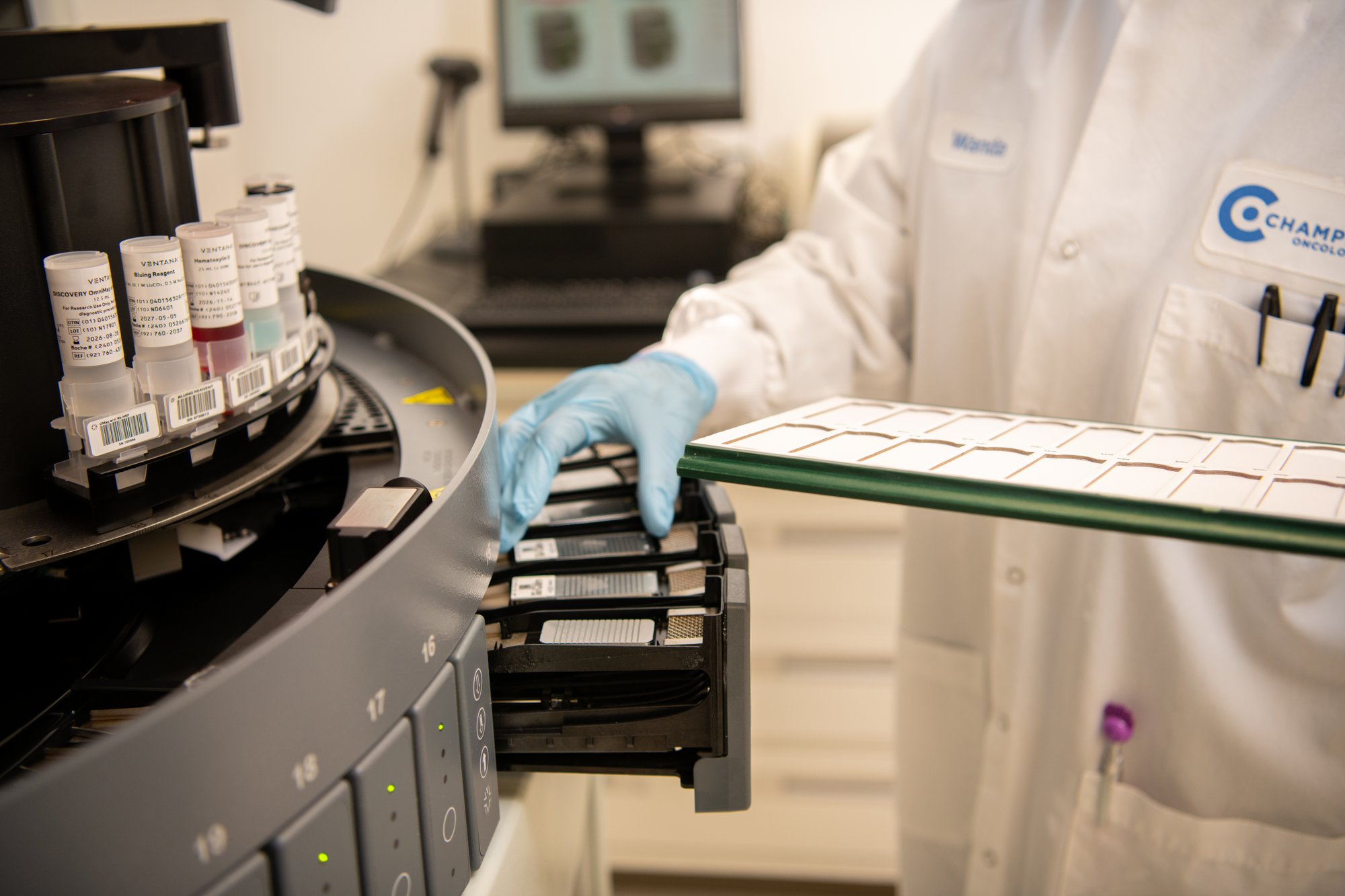
Champions has screened more than 50 KRAS-mutant PDX models with daraxonrasib across NSCLC, PDAC, and colorectal cancer. Each model connects in vivo pharmacology with clinical annotation, and a multi-omic characterization stack built to investigate response and resistance.
This is not your usual generic model list. It is a response and resistance evidence base around the pan-RAS(ON) inhibitor now reshaping KRAS development strategy.
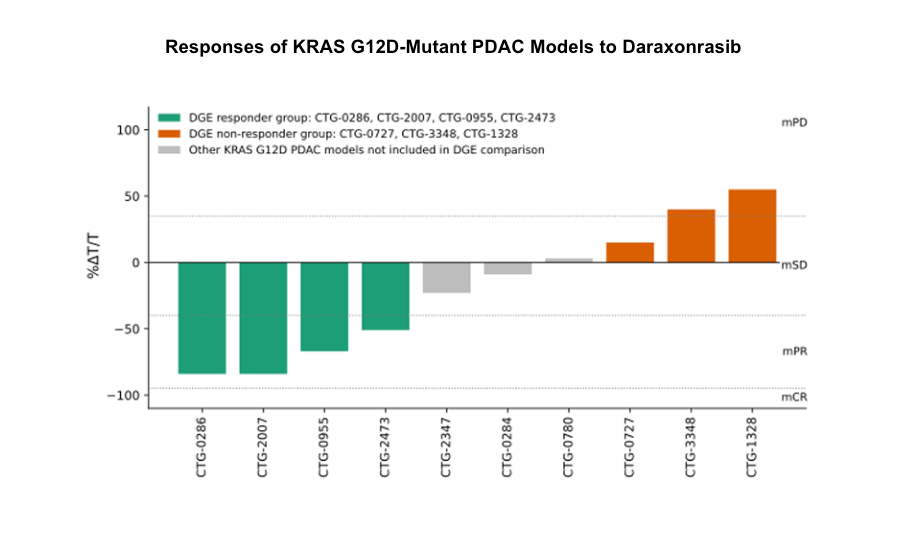
The dataset integrates in vivo pharmacology with WES, RNA-seq, whole-cell proteomics, phosphoproteomics, cell surface proteomics, KRAS allele status, co-mutations, tumor type, prior treatment history, and acquired resistance modeling under continuous drug pressure.
Targeting KRAS Mutations Webinar
The KRAS landscape is rapidly evolving, with new clinical findings highlighting the potential of G12C, G12D, G12V, pan-KRAS, and pan-RAS(ON) approaches. Discover the latest developments, key clinical insights, and innovative combination strategies driving progress across NSCLC, colorectal, and pancreatic cancers.
Our KRAS Platform.
Different KRAS programs need different kinds of evidence, which is why we provide you with three ways to use our KRAS platform; A way to start with existing data, commission prospective studies, or move from multi-omic profiling into predictive intelligence.
EXISTING DATA ASSET
RAS(ON) Intelligence Dataset
License an existing multi-omic response and resistance dataset across 50+ KRAS-mutant PDX models screened with daraxonrasib. Use it to evaluate sensitivity, resistance biology, allele context, tumor type effects, and biomarker hypotheses, for risk mitigation prior to launching a new study.
PROSPECTIVE IN VIVO STUDY
KRAS Panel
Run a prospective benchmarking study across 50+ KRAS-mutant PDX models spanning G12C, G12D, G12V, G12R, G13D, and 11 tumor types. Design model selection, study arms, omic layers, and endpoints around your program from the start to generate new evidence for your compound.
PREDICTIVE INTELLIGENCE
KRAS Intelligence Graph
Connect in vivo response, genomics, transcriptomics, proteomics, phosphoproteomics, cell surface proteomics, and pathway activity into predictive, translatable models that surface resistance mechanisms and combination hypotheses.
Why Champions for KRAS programs?
Champions did not build a KRAS capability in response to the latest clinical readout. We have been generating KRAS evidence in patient-derived models for years.
Before daraxonrasib, Champions tested adagrasib across patient-derived xenograft models prior to its FDA approval in 2022. The same foundation, metastatic and heavily pretreated patient-derived models, full clinical annotation, and deep molecular characterization, now supports a broader KRAS platform for response, resistance, benchmarking, and translational strategy.