Download Champions' AACR 2026 Poster #7214
LymphGen-Based Stratification of DLBCL PDX Models Mirrors Clinical Tumor Complexity
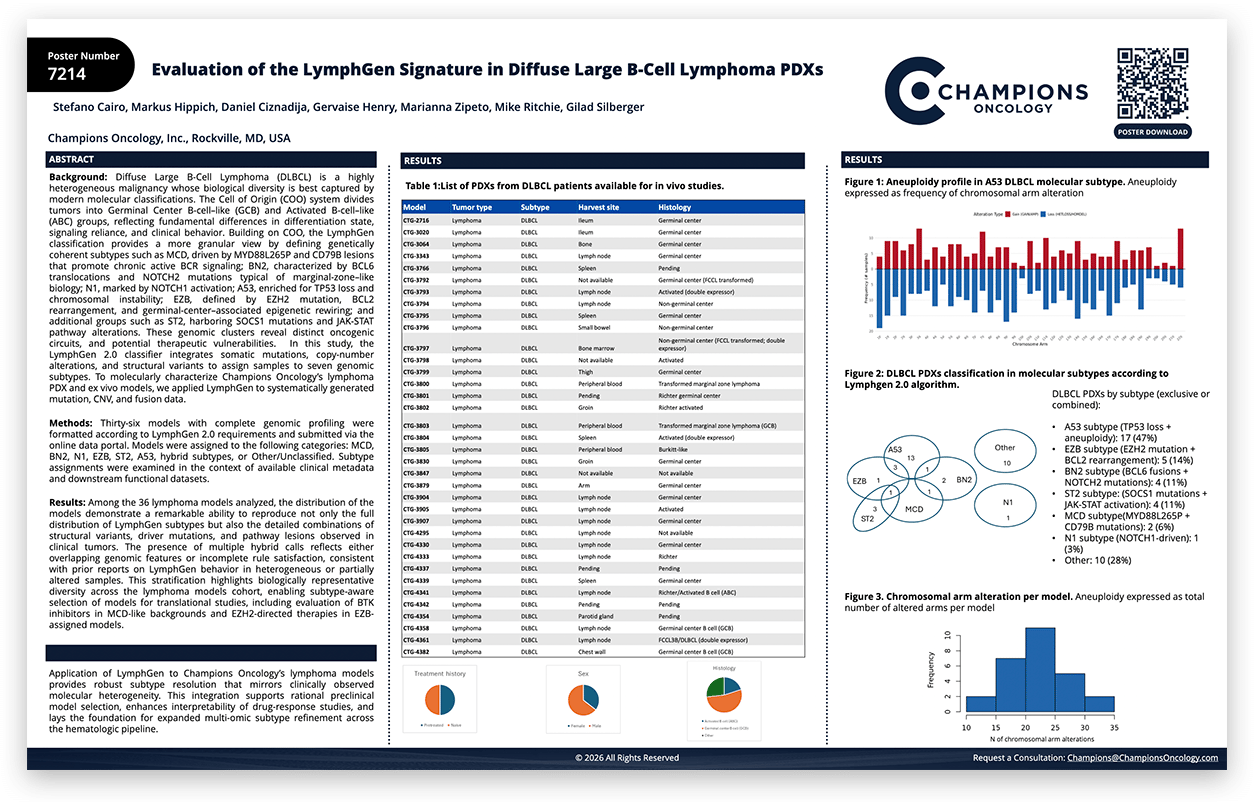
Poster #7214, presented at AACR 2026
Diffuse Large B-Cell Lymphoma (DLBCL) is a highly heterogeneous malignancy whose biological diversity is best captured by modern molecular classifications. The Cell of Origin (COO) system divides tumors into Germinal Center B-cell-like (GCB) & Activated B-cell-like (ABC) groups, reflecting fundamental differences in differentiation state, signaling reliance, & clinical behavior. Building on COO, the LymphGen classification provides a more granular view by defining genetically coherent subtypes such as MCD, driven by MYD88L265P & CD79B lesions that promote chronic active BCR signaling; BN2, characterized by BCL6 translocations & NOTCH2 mutations typical of marginal-zone-like biology; N1, marked by NOTCH1 activation; A53, enriched for TP53 loss & chromosomal instability; EZB, defined by EZH2 mutation, BCL2 rearrangement, & germinal-center-associated epigenetic rewiring; & additional groups such as ST2, harboring SOCS1 mutations & JAK-STAT pathway alterations. These genomic clusters reveal distinct oncogenic circuits, & potential therapeutic vulnerabilities. In this study, the LymphGen 2.0 classifier integrates somatic mutations, copy-number alterations, & structural variants to assign samples to seven genomic subtypes. To molecularly characterize Champions Oncology’s lymphoma PDX & ex vivo models, we applied LymphGen to generated mutation, CNV, & fusion data.Forty lymphoma models with complete genomic profiling were formatted according to LymphGen 2.0 requirements & submitted via the online data portal. Models were assigned to the following categories: MCD, BN2, N1, EZB, ST2, A53, hybrid subtypes, or Other/Unclassified. Subtype assignments were examined in the context of available clinical metadata & functional datasets.
Among the 40 lymphoma models analyzed, the distribution demonstrate a remarkable ability to reproduce not only the full distribution of LymphGen subtypes but also the detailed combinations of structural variants, driver mutations, & pathway lesions observed in clinical tumors. The presence of multiple hybrid calls reflects either overlapping genomic features or incomplete rule satisfaction, consistent with prior reports on LymphGen behavior in heterogeneous or partially altered samples. This stratification highlights biologically representative diversity across the lymphoma models cohort, enabling subtype-aware selection of models for translational studies, including evaluation of BTK inhibitors in MCD-like backgrounds & EZH2-directed therapies in EZB-assigned models.
Application of LymphGen to Champions Oncology’s lymphoma models provides robust subtype resolution that mirrors clinically observed molecular heterogeneity. This integration supports rational preclinical model selection, enhances interpretability of drug-response studies, & lays the foundation for expanded multi-omic subtype refinement across the hematologic pipeline.
Download the Poster