Download Champions' AACR 2026 Poster #7174
CAR T-Cell therapy efficacy evaluation in TumorGraft3D tri-culture platform with reconstructed tumor microenvironment
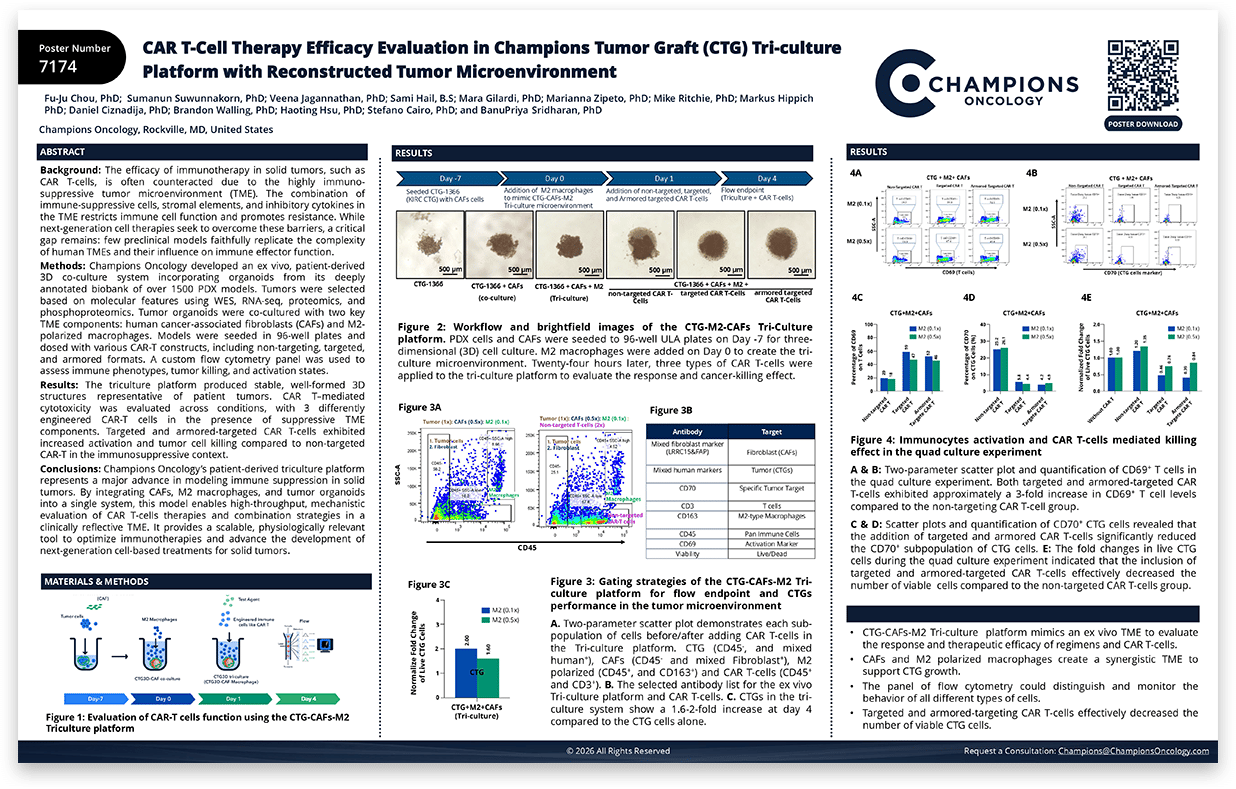
Poster #7174, presented at AACR 2026
Chimeric antigen receptor (CAR) T-cell therapy represents one of the most transformative innovations in cancer immunotherapy, offering the ability to redirect a patient’s own immune cells toward malignant targets through genetic engineering of tumor-recognizing receptors. While clinical successes in hematologic malignancies such as B-cell acute lymphoblastic leukemia & diffuse large B-cell lymphoma have validated the concept of CAR T-cell-mediated cytotoxicity, extending this efficacy to solid tumors has proven significantly more challenging due to the immunosuppressive nature of the tumor microenvironment (TME), the heterogeneity of antigen expression, &the presence of physical & biochemical barriers that limit CAR T-cell infiltration & persistence.To address these limitations, we developed the TumorGraft3D-Tri-Culture platform, a physiologically relevant ex-vivo system capable of recapitulating the complex interactions that occur among tumor cells, cancer- associated fibroblasts (CAFs), & immune suppressive components such as M2 macrophages. In this study, CD70-directed CAR T-cells were evaluated in a renal cell carcinoma with high CD70 expression. Standard targeted CAR T-cells expressing the CD27 receptor were compared to armored CAR T-cells incorporating a dominant-negative TGFβ receptor II (dnTGFβRII) designed to resist TGFβ-mediated immunosuppression. The tri-culture system consisted of tumor cells, cancer-associated fibroblasts (CAFs), & M2 macrophages, providing a physiologically relevant TME that supported tumor proliferation & cytokine-driven immune suppression.
Addition of CAR T-cells enabled a quad-culture system used to assess therapeutic efficacy under suppressive conditions. Tumor cells were seeded at a 1x baseline ratio, with CAFs at 0.5x & M2 macrophages at 0.1-0.5x. Both targeted & armored CAR T-cells reduced tumor viability compared with controls, but armored CAR T-cells showed enhanced cytotoxicity & sustained activation. CD69 expression was markedly elevated in both CAR T-cell types, indicating robust activation, while CD70 surface expression on tumor cells decreased following treatment, reflecting target engagement & selective killing. Brightfield imaging & luminescence analyses confirmed significant tumor lysis, especially in armored CAR T-cell groups.
The 3D platform successfully recapitulated stromal & immune-mediated resistance mechanisms absent in conventional two-dimensional systems, validating its translational relevance. These findings demonstrate that TGFβ-resistant armored CAR T-cells maintain effector function within an immunosuppressive TME & highlight CD70 as a viable & selective therapeutic target. Collectively, this work establishes the TumorGraft3D tri-culture platform as a robust preclinical tool for evaluating & advancing next-generation CAR T-cell therapies in solid tumors.
Download the Poster