Download Champions' AACR 2026 Poster #6415
Scalable chem-seq and functional-seq platforms for profiling chemical and genetic perturbations in patient-derived organoids
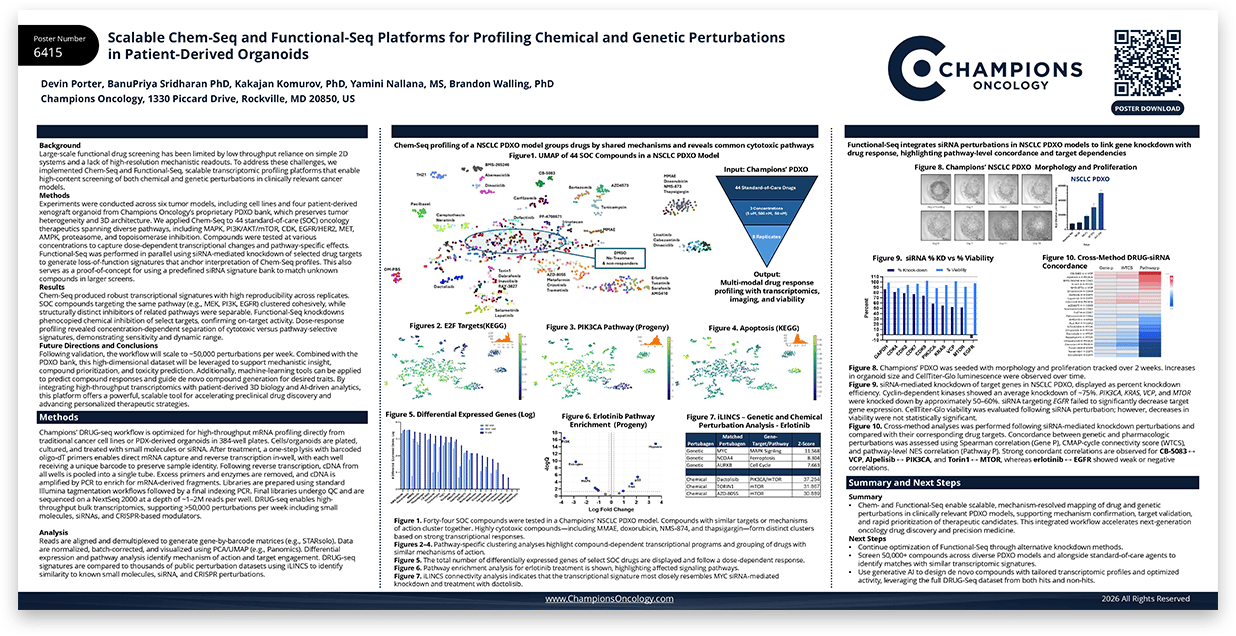
Poster #6415, presented at AACR 2026
Large-scale functional drug screening has been limited by low throughput reliance on simple 2D systems and a lack of high-resolution mechanistic readouts. To address these challenges, we implemented Chem-Seq and Functional-Seq, scalable transcriptomic profiling platforms that enable high-content screening of both chemical and genetic perturbations in clinically relevant cancer models. Methods Experiments were conducted across six tumor models, including cell lines and four patient-derived xenograft organoids from Champions Oncology’s proprietary Patient-Derived Xenograft Organoid (PDXO) bank, which preserves tumor heterogeneity and 3D architecture. We applied Chem-Seq to 44 standard-of-care (SOC) oncology therapeutics spanning diverse pathways, including MAPK, PI3K/AKT/mTOR, CDK, EGFR/HER2, MET, AMPK, proteasome, and topoisomerase inhibition. Compounds were tested at various concentrations to capture dose-dependent transcriptional changes and pathway-specific effects. Functional-Seq was performed in parallel using siRNA-mediated knockdown of selected drug targets to generate loss-of-function signatures that anchor interpretation of Chem-seq profiles. This also serves as a proof-of-concept for using a predefined siRNA signature bank to match unknown compounds in larger screens.
Results
Chem-Seq produced robust transcriptional signatures with high reproducibility across replicates. SOC compounds targeting the same pathway (e.g., MEK, PI3K, EGFR) clustered cohesively, while structurally distinct inhibitors of related pathways were separable. Functional-Seq knockdowns phenocopied chemical inhibition of select targets, confirming on-target activity. Dose-response profiling revealed concentration-dependent separation of cytotoxic versus pathway-selective signatures, demonstrating sensitivity and dynamic range.
Future Directions and Conclusions
Following validation, the workflow will scale to ~50,000 perturbations per week. Combined with the PDXO bank, this high-dimensional dataset will be leveraged to support mechanistic insight, compound prioritization, and toxicity prediction. Additionally, machine-learning tools can be applied to predict compound responses and guide de novo compound generation for desired traits. By integrating high-throughput transcriptomics with patient-derived 3D biology and AI-driven analytics, this platform offers a powerful, scalable tool for accelerating preclinical drug discovery and advancing personalized therapeutic strategies.Download the Poster