Download Champions' AACR 2026 Poster #5812
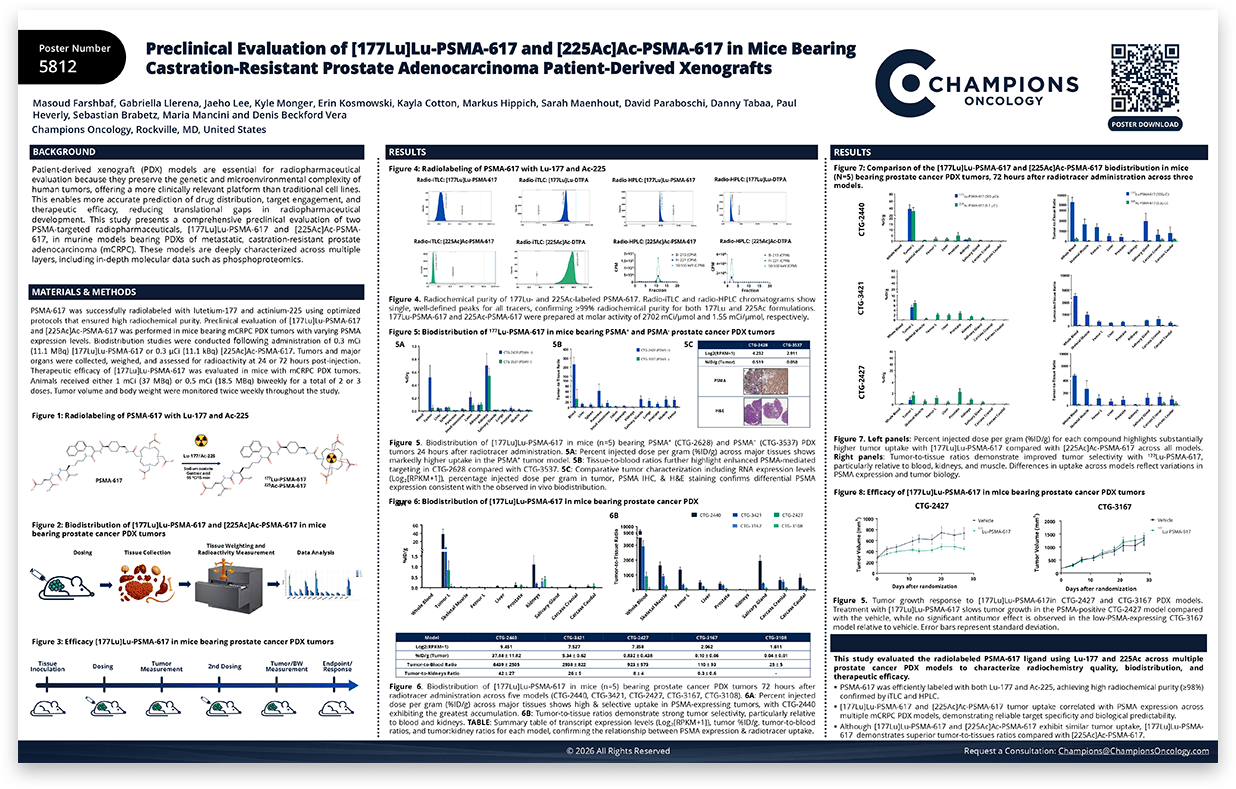
Preclinical evaluation of [177Lu] Lu-PSMA-617 and [225Ac] Ac-PSMA-617 in mice bearing castration-resistant prostate adenocarcinoma patient-derived xenografts
Poster #5812, presented at AACR 2026
Background Patient-derived xenograft (PDX) models are essential for radiopharmaceutical evaluation because they preserve the genetic and microenvironmental complexity of human tumors, offering a more clinically relevant platform than traditional cell lines. This enables more accurate prediction of drug distribution, target engagement, and therapeutic efficacy, reducing translational gaps in radiopharmaceutical development. This study presents a comprehensive preclinical evaluation of two PSMA-targeted radiopharmaceuticals, [177Lu]Lu-PSMA-617 and [225Ac]Ac-PSMA-617, in murine models bearing PDXs of metastatic, castration-resistant prostate adenocarcinoma. These models are deeply characterized across multiple layers, including in-depth molecular data such as phosphoproteomics. Methods PSMA-617 was successfully radiolabeled with lutetium-177 and actinium-225 using optimized protocols that ensured high radiochemical purity. Preclinical evaluation of [177Lu]Lu-PSMA-617 and [225Ac]Ac-PSMA-617 was conducted in mice bearing CTG-2428 (PSMA+) PDX tumors derived from a 67-year-old Caucasian male with metastatic, castration-resistant prostate adenocarcinoma, and CTG-3537 (PSMA-) PDX tumors derived from a 63-year-old African American male with metastatic, castration-resistant prostate adenocarcinoma. Biodistribution studies of [177Lu]Lu-PSMA-617 were performed in mice bearing PSMA+ and PSMA- PDX tumors. Mice received 0.3 mCi (11 MBq) [177Lu]Lu-PSMA-617, and tumors and major organs were collected, weighed, and measured for radioactivity 24 hours post-injection.Therapeutic efficacy of [177Lu]Lu-PSMA-617 and [225Ac]Ac-PSMA-617 was assessed in mice bearing CTG-2428 (PSMA+) PDX tumors. Mice received 1 mCi (37 MBq) of [177Lu]Lu-PSMA-617 or 1 μCi (37 kBq) of [225Ac]Ac-PSMA-617, and tumor size and body weight were measured twice weekly throughout the study. Results [177Lu]Lu-PSMA-617 and [225Ac]Ac-PSMA-617 were obtained with radiochemical purity greater than 98%, as determined by radio-TLC and radio-HPLC. The radiotracers demonstrated selective uptake in PSMA-positive tumors, with minimal accumulation in PSMA-negative PDX, confirming target specificity. Importantly, the radiotracers showed excellent tumor-to-tissues ratios. Both agents significantly inhibited tumor growth compared to controls in mice bearing PSMA-positive PDX tumors. Treatment was well tolerated, with no significant weight loss or acute toxicity observed.
Conclusions Further studies are warranted to optimize dosing strategies and evaluate long-term safety. Importantly, this work underscores the critical role of PDX models in capturing real receptor expression and tumor heterogeneity, thereby enhancing the translational relevance of radiopharmaceuticals in preclinical development.
Download the Poster