Download Champions' AACR 2026 Poster #4868
Modelling glioblastoma sensitivity to irradiation with a patient derived xenograft-derived 3D platform
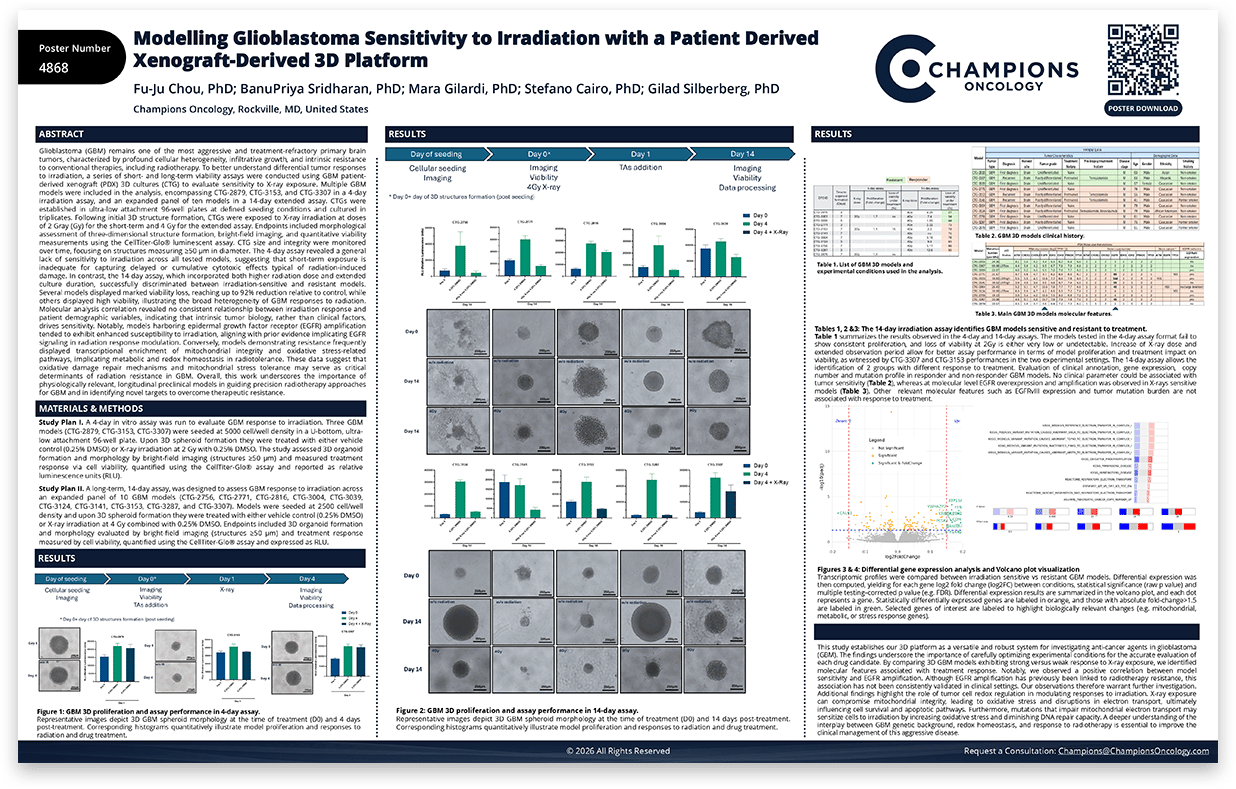
Poster #4868, presented at AACR 2026
Glioblastoma (GBM) remains one of the most aggressive and treatment-refractory brain tumors, characterized by profound cellular heterogeneity, infiltrative growth, and intrinsic resistance to conventional therapies, including radiotherapy. To better understand differential tumor responses to irradiation, a series of short & long-term viability assays were conducted using glioblastoma patient-derived xenograft organoids (PDXO) to evaluate sensitivity to X-ray exposure. Multiple GBM models were included in the analysis, in a 4-day irradiation assay, & an expanded panel of ten models in a 14-day extended assay. Organoids were established in ultra-low attachment 96-well plates at defined seeding and cultured in triplicate. Following initial organoid formation, PDXOs were exposed to X-ray irradiation at doses of 2 Gray (Gy) for the short-term & 4 Gy for the extended assay. Endpoints included morphological assessment of three-dimensional structure formation, bright-field imaging, & quantitative viability measurements using the CellTiter-Glo® luminescent assay. Organoid size & integrity were monitored over time, focusing on structures measuring ≥50 μm in diameter. The 4-day assay revealed a general lack of sensitivity to irradiation across all tested models, suggesting that short-term exposure is inadequate for capturing delayed or cumulative cytotoxic effects typical of radiation-induced damage.In contrast, the 14-day assay, which incorporated both higher radiation dose & extended culture duration, successfully discriminated between irradiation-sensitive & resistant models. Several organoids displayed marked viability loss, reaching up to 92% reduction relative to control, while others displayed high viability, illustrating the broad heterogeneity of GBM responses to radiation. Analysis of molecular correlates revealed no consistent relationship between irradiation response and patient demographic variables, indicating that intrinsic tumor biology, rather than clinical factors, drives sensitivity. Notably, models harboring epidermal growth factor receptor (EGFR) amplification tended to exhibit enhanced susceptibility to irradiation, aligning with prior evidence implicating EGFR signaling in radiation response modulation. Conversely, models demonstrating resistance displayed transcriptional enrichment of mitochondrial integrity and oxidative stress-related pathways, implicating metabolic and redox homeostasis in radiotolerance.
These data suggest that oxidative damage repair mechanisms and mitochondrial stress tolerance may serve as critical determinants of radiation resistance in GBM. Overall, this work underscores the importance of physiologically relevant, longitudinal preclinical models in guiding precision radiotherapy approaches for glioblastoma and in identifying novel targets to overcome therapeutic resistance.
Download the Poster