Download Champions' AACR 2026 Poster #2832
Evaluation of Natural Killer cells’ Contribution to the Efficacy of Immuno-oncology Regimens in Patient Derived Xenograft-Derived 3D Models
Poster #2832, presented at AACR 2026
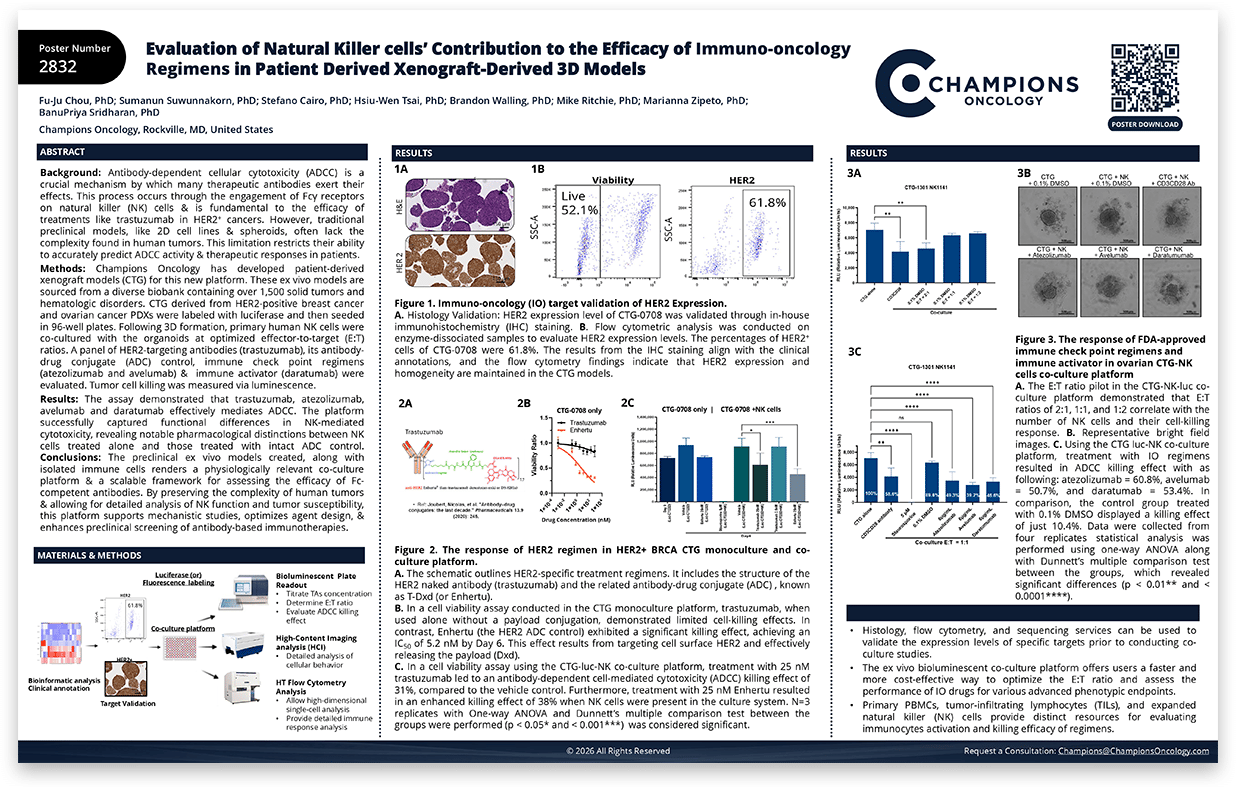
Evaluating the impact of natural killer (NK) cells on antibody-drug conjugate (ADC) activity is essential for understanding and optimizing treatment efficacy. NK cells play a critical role in mediating antibody-dependent cellular cytotoxicity (ADCC), one of the key mechanisms through which ADCs exert their therapeutic effects. By recognizing and eliminating tumor cells via ADC Fc receptor engagement, NK cells can enhance the overall cytotoxic response and influence treatment outcomes. Assessing this interaction provides valuable insights into resistance mechanisms, guides the design of next-generation ADCs with improved immune engagement, and helps identify patient populations most likely to benefit from such therapies.The primary objective of this study was to evaluate the contribution of NK cells to the cytotoxic activity and potential toxicity of trastuzumab deruxtecan (Enhertu) in breast cancer patient-derived xenograft organoid cultures (TumorGraft3D). A luciferase-tagged TumorGraft3D co-culture system incorporating a BioGlo luminescence endpoint was employed to enable real-time assessment of tumor cell viability and treatment response in the presence or absence of NK cells. A 3D co-culture system was established using breast cancer models that were transduced with luciferase at a multiplicity of infection (MOI) of 10 to allow quantifiable luminescence-based viability measurements. Following successful transduction, NK cells were added at predetermined ratios to the organoid cultures. Imaging and luminescence measurements were conducted at multiple time points to evaluate dynamic changes in cell viability and treatment effects. TumorGraft3D cells were seeded and transduced with luciferase. After confirming signal stability, NK cells, Enhertu or Trastuzumab were introduced into the culture system. Viability and imaging analyses were performed on Day 1 and Day 4 post-seeding, capturing both early and delayed treatment effects. Brightfield microscopy was used to visualize morphological changes, and BioGlo luminescence readings quantified cell survival and treatment response.
In the CTG-0708 model of HER2+ invasive ductal carcinoma, the addition of NK cells resulted in a slight increase in Enhertu-mediated cytotoxicity, suggesting a modest but measurable enhancement of ADC activity in the presence of NK cells. Trastuzumab efficacy demonstrated a clear correlation with antibody concentration, indicating dose-dependent ADCC activity. In contrast, Enhertu toxicity appeared independent of antibody concentration, likely due to the previously shown inefficient release of payload in vitro.
These findings suggest a potential immunomodulatory effect of NK cells on ADC efficacy, and support the use of this platform to more accurately model ADC mechanisms of action.
Download the Poster