
Poster
AACR 2026 Poster #6415
Scalable chem-seq and functional-seq platforms for profiling chemical and genetic perturbations in patient-derived organoids
Summary
Results
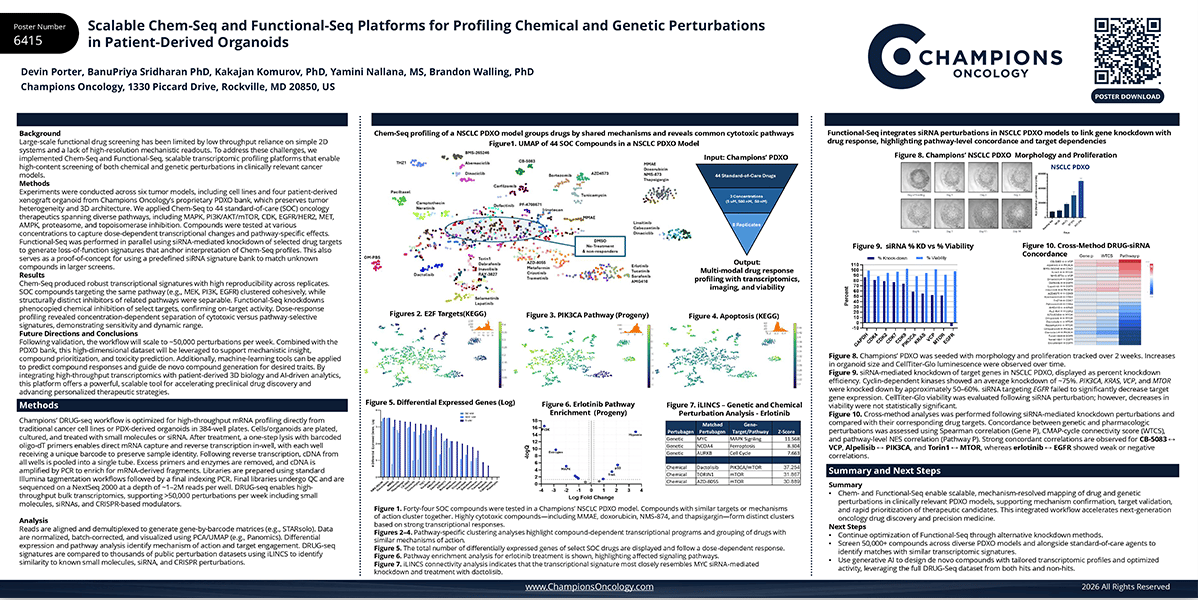
Chem-Seq produced robust transcriptional signatures with high reproducibility across replicates. SOC compounds targeting the same pathway (e.g., MEK, PI3K, EGFR) clustered cohesively, while structurally distinct inhibitors of related pathways were separable. Functional-Seq knockdowns phenocopied chemical inhibition of select targets, confirming on-target activity. Dose-response profiling revealed concentration-dependent separation of cytotoxic versus pathway-selective signatures, demonstrating sensitivity and dynamic range.
Future Directions and Conclusions
Following validation, the workflow will scale to ~50,000 perturbations per week. Combined with the PDXO bank, this high-dimensional dataset will be leveraged to support mechanistic insight, compound prioritization, and toxicity prediction. Additionally, machine-learning tools can be applied to predict compound responses and guide de novo compound generation for desired traits. By integrating high-throughput transcriptomics with patient-derived 3D biology and AI-driven analytics, this platform offers a powerful, scalable tool for accelerating preclinical drug discovery and advancing personalized therapeutic strategies.