
Poster
AACR 2025 Poster
Clinical relevance and translatability of NSCLC patient-derived xenograft (PDX) models for evaluating cMET-targeted therapies
Summary
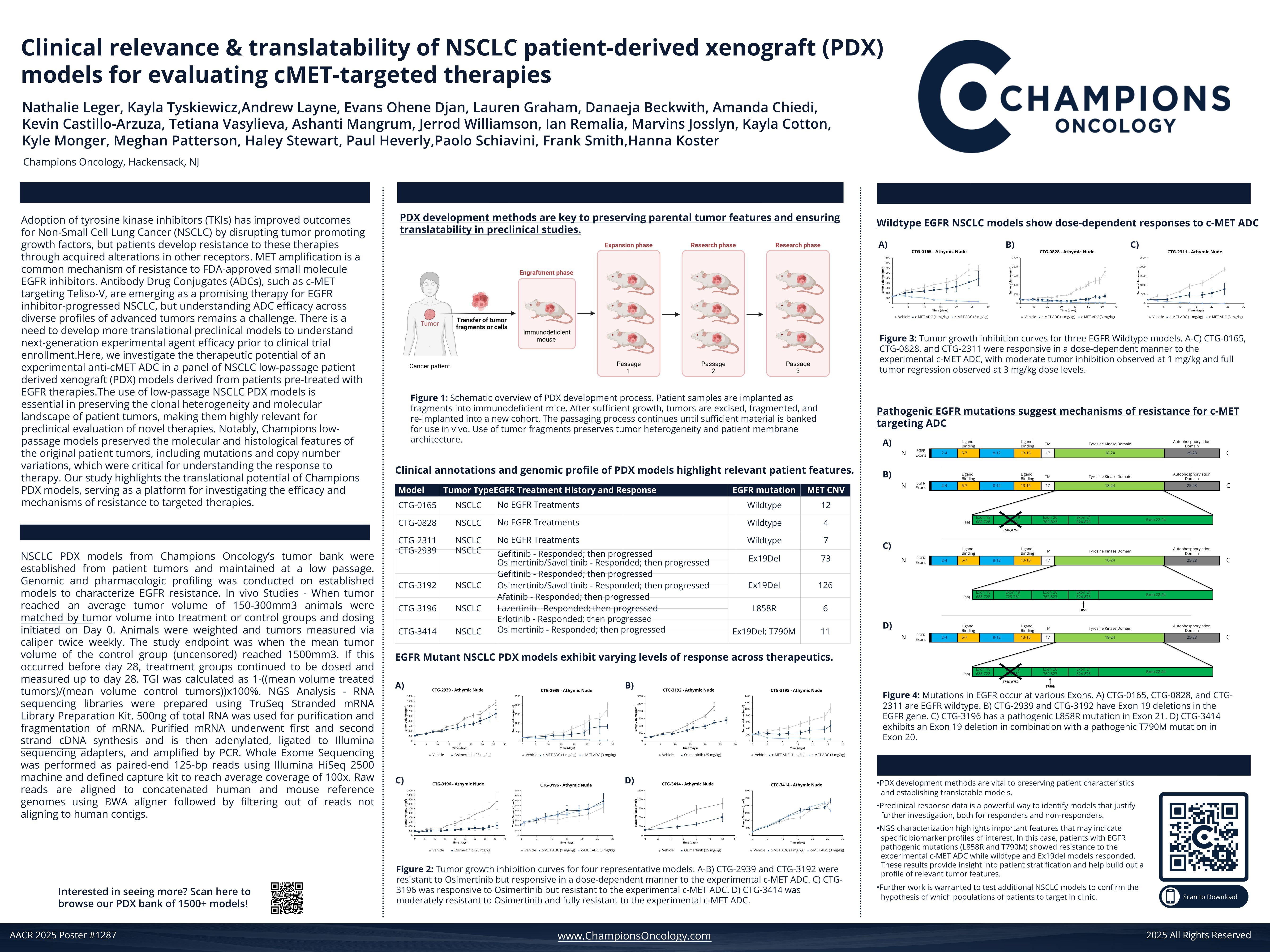
One of the key challenges in evaluating next-generation therapies for NSCLC is the lack of preclinical models that accurately preserve the molecular complexity and resistance mechanisms of patient tumors. Resistance to EGFR-targeted TKIs often involves c-MET amplification, underscoring the need for models that replicate this biology. Antibody-drug conjugates (ADCs) targeting c-MET, like Teliso-V, show potential, but robust translational systems are required to assess their efficacy across heterogeneous tumor types.
Champions Oncology developed low-passage NSCLC patient-derived xenograft (PDX) models that maintain the clonal architecture and mutational landscape of the original tumors, making them highly translatable for preclinical evaluation.
Champions Oncology developed low-passage NSCLC patient-derived xenograft (PDX) models that maintain the clonal architecture and mutational landscape of the original tumors, making them highly translatable for preclinical evaluation.
In vivo studies demonstrated dose-dependent responses to a c-MET-targeting ADC across EGFR wildtype and mutant PDX models, with efficacy observed even in models resistant to osimertinib.
Deep genomic profiling revealed distinct EGFR mutations (e.g., Ex19Del, L858R, T790M) and MET copy number variations that influenced therapeutic response and resistance patterns.
The dataset supports the utility of Champions’ NSCLC PDX models for screening targeted therapies and guiding patient stratification in the clinic, offering a valuable platform to predict ADC efficacy in EGFR inhibitor-progressed tumors.