Download Champions' NYAS 2019 Poster
Unique Immunodeficient Murine Host Strains Impact Expansion and Engraftment of T Cells in PBMC Humanized Mice
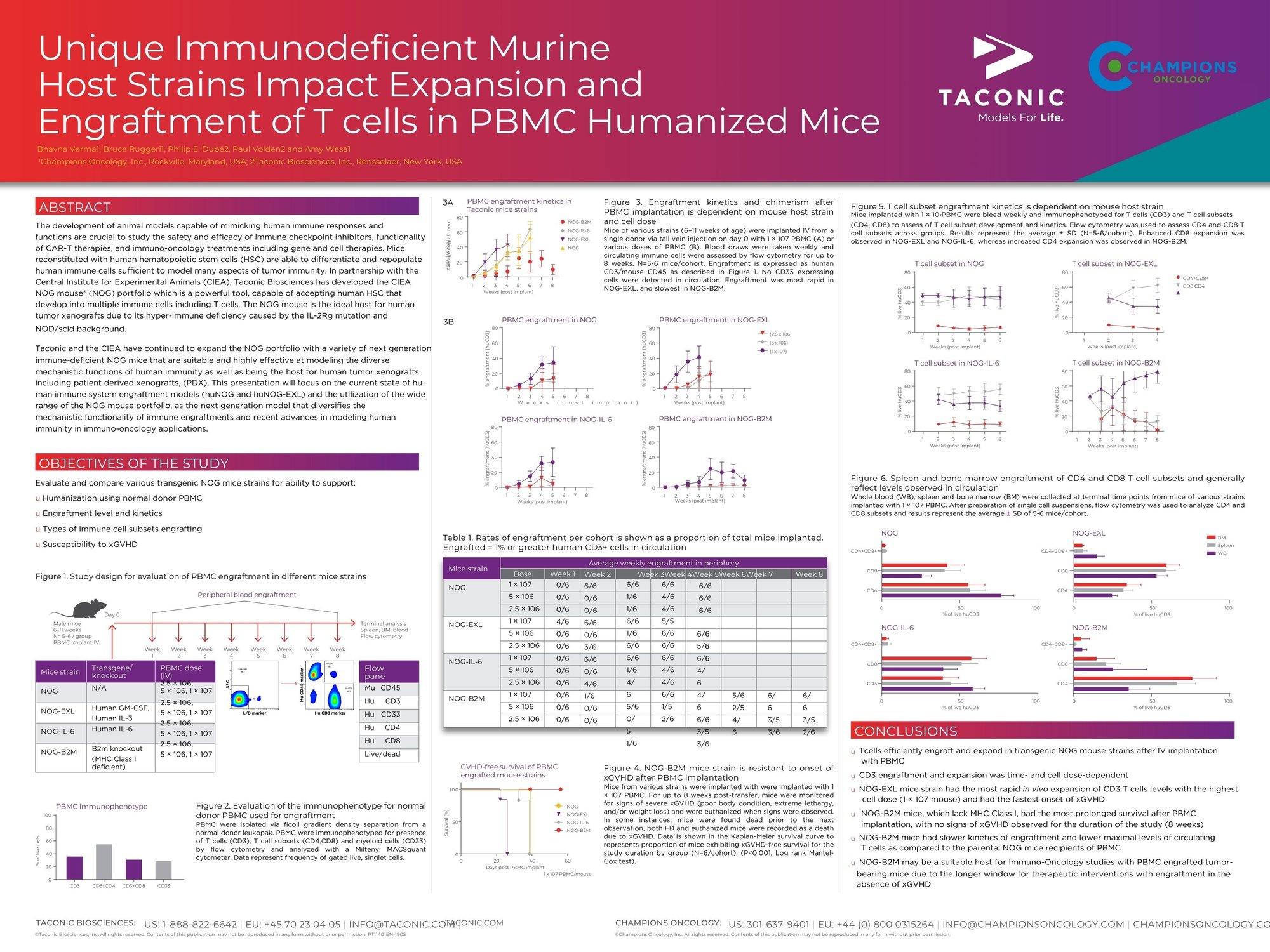
Animal models that replicate human immune responses are essential for evaluating the safety and efficacy of immune checkpoint inhibitors, CAR-T therapies, and immuno-oncology treatments. Mice reconstituted with human hematopoietic stem cells (HSC) can differentiate into various human immune cells, enabling tumor immunity modeling. In partnership with the Central Institute for Experimental Animals (CIEA), Taconic Biosciences developed the NOG mouse® (NOG) portfolio, which supports human immune system engraftment and is ideal for human tumor xenografts due to its hyper-immune deficiency. The NOG portfolio has expanded to include next-generation immune-deficient mice, such as huNOG and huNOG-EXL, for advanced immuno-oncology research and patient-derived xenografts (PDX).
- Animal models that mimic human immune responses are key to studying immunotherapy treatments like immune checkpoint inhibitors and CAR-T therapies.
- The CIEA NOG mouse® (NOG) portfolio, developed with Taconic Biosciences, supports human immune system engraftment, making it ideal for tumor immunity modeling and human tumor xenografts.
- The NOG portfolio has expanded with next-gen immune-deficient models, such as huNOG and huNOG-EXL, to enhance research in immuno-oncology and patient-derived xenografts (PDX).