Download Champions' latest SITC 2023 Poster
Computational Deconvolution Identifies a Th2-enriched Immune-Inflammatory Signature in Invasive Breast Carcinoma
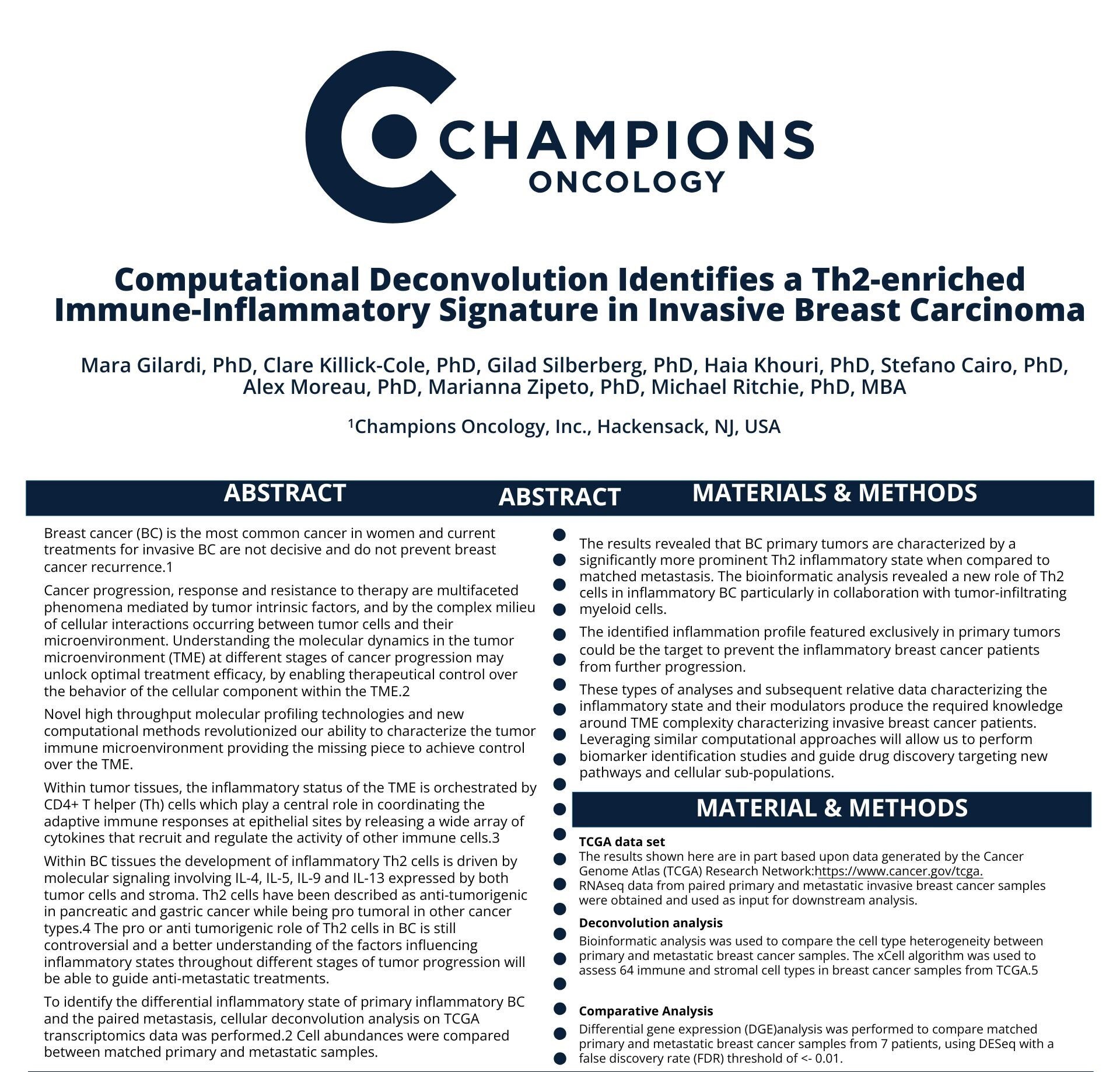
Breast cancer (BC) is the most common cancer in women, with current treatments failing to decisively prevent recurrence. Cancer progression and therapy resistance are driven by tumor intrinsic factors and complex interactions within the tumor microenvironment (TME). Understanding the molecular dynamics of the TME at different cancer stages is key to improving treatment efficacy. New high-throughput molecular profiling and computational methods now enable a deeper characterization of the TME, which is crucial for controlling its behavior. Specifically, CD4+ T helper (Th) cells regulate the inflammatory status of the TME, and Th2 cells, while controversial in BC, could influence tumor progression. To investigate this, we conducted cellular deconvolution analysis on TCGA transcriptomics data, comparing inflammatory states between primary and metastatic BC tissues.
-
Breast cancer treatment struggles with recurrence due to complex tumor microenvironment (TME) interactions.
-
New molecular profiling and computational methods allow for better characterization and control of the TME.
-
Cellular deconvolution analysis revealed differential inflammatory states between primary and metastatic BC tissues, highlighting the role of Th2 cells.